
Command center
Mission Control turns AI work into an operating surface.
Users start from clear next actions, active Runs, readiness, and finished Artifacts instead of scattered conversations.
opheli.ai helps you launch structured AI Missions with Context, Operators, Runs, Artifacts, and Mission Replay so work is not trapped in a chat thread.
Your keys. Your spend. Our execution layer.
Mission Control
A structured run moves through planning, specialist execution, review, and final artifact packaging.
Mission Orb
Next Best Action: Review Replay before release.
Mission Replay
Traceable decisions and review
Artifact Preview
01
Planning locked
02
Specialists delivered findings
03
Reviewer challenged one claim
04
Artifact packaged
The strongest opheli.ai features are not one-off prompts. They create operating memory, proof, governance, and reusable execution patterns around provider models.
Command center
Users start from clear next actions, active Runs, readiness, and finished Artifacts instead of scattered conversations.
Multi-operator work
Research, writing, review, and technical lanes can move through one accountable Run instead of disappearing into a single chat response.
Proof layer
Every Run can carry timeline, evidence, risk pressure, review signals, and Artifact readiness for human review.
Provider independence
BYOK separates platform access from model spend while letting users choose the providers that fit their work.
Repeatable execution
Successful work can become reusable execution structure without turning private customer data into a shared training pool.
Chat is useful for exploration, but serious work needs structure, review, proof, and a finished delivery surface.
01
Source material is easy to lose once a thread gets long.
02
There is no clear run model for planning, work, review, and packaging.
03
A good workflow rarely becomes a reusable operating pattern.
04
Challenges, approvals, and revisions happen outside the work itself.
05
You see output, not a clean record of how it formed.
06
Final work gets mixed with messages instead of landing as an Artifact.
opheli.ai keeps the workflow simple enough for first use and structured enough for repeatable work.
Add Source Material, notes, files, or briefings through Context Vault.
Use specialized Operators for research, strategy, review, writing, and technical work.
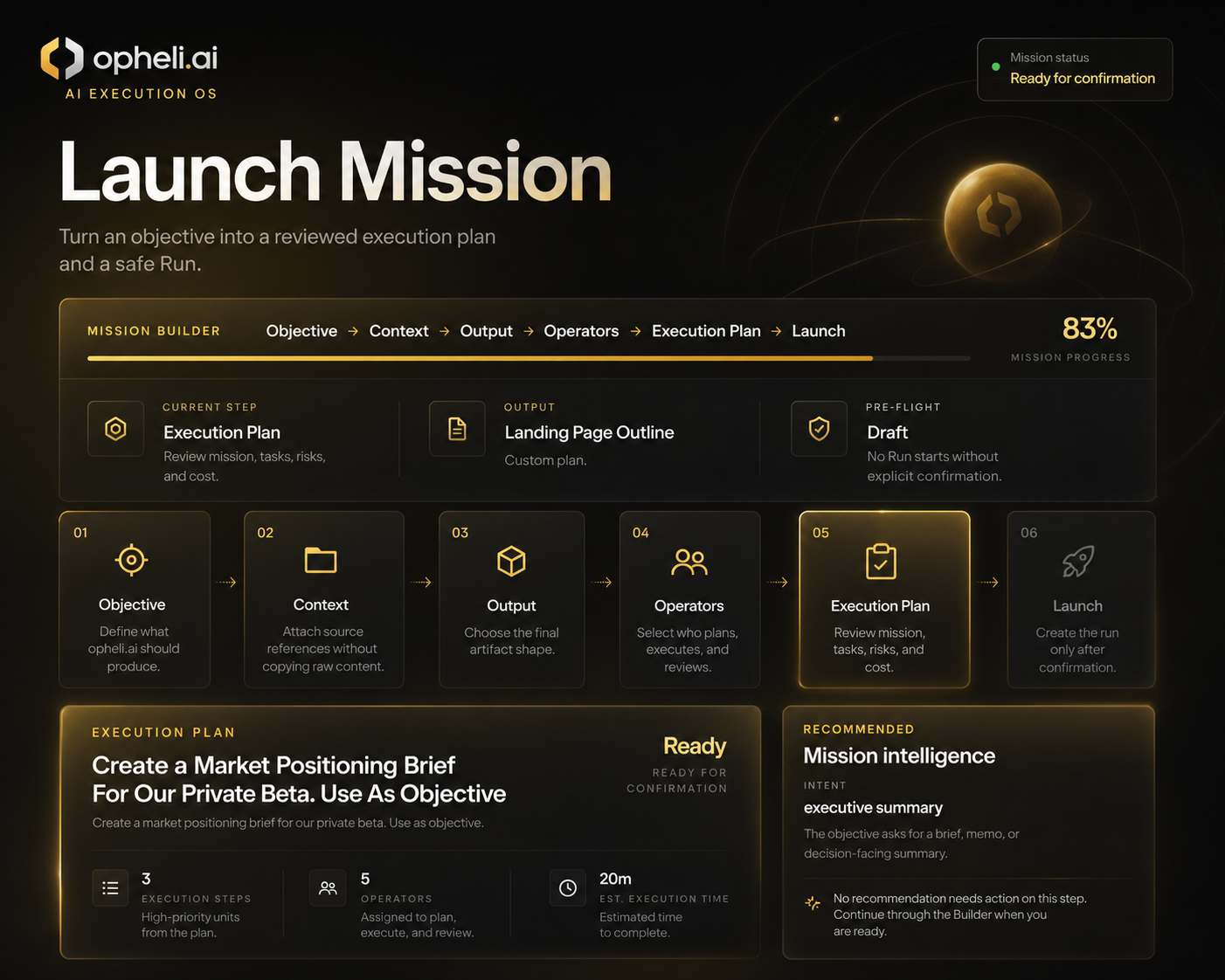
Mission Builder turns your objective into a structured execution plan.
Runs move through planning, specialist execution, review, and final artifact creation.
Mission Replay shows how the work happened before you rely on it.
Artifacts are finished deliverables, not chat transcripts or hidden drafts.
Each core surface is there to make AI work more accountable, easier to review, and easier to reuse.
Operator Room
Mission Builder
Frame objectives, outputs, operators, and context before work starts.
Context Vault
Keep notes, files, and briefings close to the mission that needs them.
Operators
Coordinate research, analysis, review, writing, and technical lanes cleanly.
Official Blueprints are curated by opheli.ai. They define Context Requirements, Operators, execution steps, Quality Rules, and expected Artifacts.
Curated by opheli.ai. This is not an open marketplace.
Mission Replay gives every Run a timeline for planning, operators, decisions, review, cost posture, and the final Artifact.
Planning
Objective interpreted, operator lanes assigned, context selected.
Specialist execution
Findings, claims, and draft direction move through specialist lanes.
Review
Unsupported claims are challenged before the work clears.
Final artifact
A polished output lands with its execution story still attached.
Connect OpenAI, Anthropic, or compatible providers through Provider Vault. Keys are encrypted at rest, handled server-side, and not shown again after save.
opheli.ai is designed with server-side provider handling, bounded support context, and visible legal/privacy surfaces without making inflated compliance claims.
Provider credentials are encrypted at rest and used only server-side.
Account security includes two-factor support where enabled in the product.
Support flows avoid attaching full prompts, provider keys, or full private context automatically.
Privacy, terms, cookie policy, imprint, and AI disclaimer stay visible from the public product shell.
Platform access and provider usage are separate. Private beta access is managed deliberately while commercial packaging is configured for the right team shape.
Do not assume provider usage is bundled. BYOK remains the default posture.
The strongest fit is work that needs specialists, visible execution, and a finished deliverable.
The short version: opheli.ai is built for structured AI work, not just fast chat output.
opheli.ai is an AI Execution OS for turning objectives into structured AI work with Missions, Runs, Artifacts, and Replay.
No. Chat can exist around the system, but the product itself is built around execution, review, and final deliverables.
For live provider work, yes. You can also use Mock Mode to explore the product without external provider usage.
Your connected provider account does. Platform access is separate from provider usage.
Operators are specialized AI roles for research, analysis, review, writing, and other execution lanes.
A Mission is the objective layer that turns into executable work through Tasks and Runs.
A Run is the execution record that moves through planning, specialist execution, review, and final artifact creation.
An Artifact is the finished deliverable, separate from the execution message trail that formed it.
Mission Replay is the proof-of-work timeline that shows how the run actually happened.
Official Blueprints are curated execution patterns published by opheli.ai. Users do not publish them as an open marketplace.
Provider keys are encrypted at rest, handled server-side for execution, and not shown again after save.
Yes. Context Vault is built for attaching notes, files, and briefings to the work that needs them.
You can inspect Replay, retry failed steps, continue work where appropriate, or report the run through product support.
Start with a mission, keep the proof, and end with a deliverable your team can actually use.